Like Some Tea?


Professor Dick Bawlkins is one of the world’s leading professors. He’s written the best-selling books, has earned the respect of his fellow professors from across the globe, and has a reputation among students as being the best of the best. This guy is a top-of-the-line educator, and everybody knows it.
Mr. Bawlkins takes an interest in the life of secluded monks, and so he travels to a remote monastery to live with them for a while and learn what they’re all about. Upon arrival, a friendly monk greets him by stating his name, and that he’ll be happy to teach the Professor about his way of life.
Professor Bawlkins, however, greets the monk by saying much more than just his name—he also throws in his PHD title, his tenure high-paying job, his bestseller books he’s known for around the globe, and his big bad reputation within the education system. He also says how he’s gonna write another best seller after he’s done learning all about the monk’s life.
The monk asks him, “Would you like some tea?”
Professor Bawlkins says, “Sure.”
The monk invites him inside his humble house, into his little kitchen, and the Professor takes a seat. The monk places a small white teacup upon the wooden table, and begins to pour him some tea.
And keeps pouring.
The monk keeps pouring until the tea pours out over the cup, and spills unto the wooden table. The Professor says, “What are you doing? You’re spilling the tea, you’re wasting it.”
The monk stops pouring the tea, smiles at him, and says, “If I am to teach you anything, first you must empty your cup. Or else my every word will flow out of your mind and be wasted, just like this tea.”
 “It is the mark of educated man to be able to entertain a thought without accepting it.”

-Aristotle
I include that quote again because it deserves being mentioned twice. Thanks Aristotle. Entertaining a thought, giving it time and attention, no matter how outlandish it may be, is a requirement for a real education. Learning requires an “empty cup,” meaning a mind that has not 100% concluded everything about life, reality, and the universe. Once it’s “filled,” it needs to be emptied, so a new flavor can be tested out, over and over again. How can you develop taste if you’ve only ever tasted one thing?
A mind is like a parachute—it don’t work if ain’t open. Learning requires a mind that is open to new possibilities, to unseen variables, with a conscious willingness to discover that it is wrong. A true mind will always seek for its own false perceptions. It will always challenge its own perception of truth throughout every turn in life. It will always assault its every cherished thought no matter how uncomfortable it gets. For truth is indestructible.
There is always another variable to discover, it doesn’t matter how advanced our species gets. Reality flows. Keep up. A mind that has all the answers, is a mind that no longer questions. And a mind that no longer questions, is no mind at all.

But at the same time, if your mind opens too much, your brain could fall out. There is balance to be found between open-minded free investigation and critically challenging skepticism, between allowing information into yourself and questioning that information with everything you’ve got, between exploring unfamiliar territory and remaining founded in the familiar.
Too much comforting acceptance and you become a pawn, a push over, a victim. Too much rigid skepticism and you become a robot, a dead block, a tyrant.
Learning can only happen when there is no immediate rejection and no immediate acceptance. Whether it’s a secure rejection or a comforting acceptance, it will prevent learning. But there is a healthy, vibrating center point between the extremes. A place where new information can be taken in, but not immediately accepted as true. And that is where you want to be if you wish to learn. Always challenge, and always explore.
The following graph illustrates this, it is the “Teachability Bell Curve.” And it is, without a doubt, something everyone needs to understand if they wish to learn.
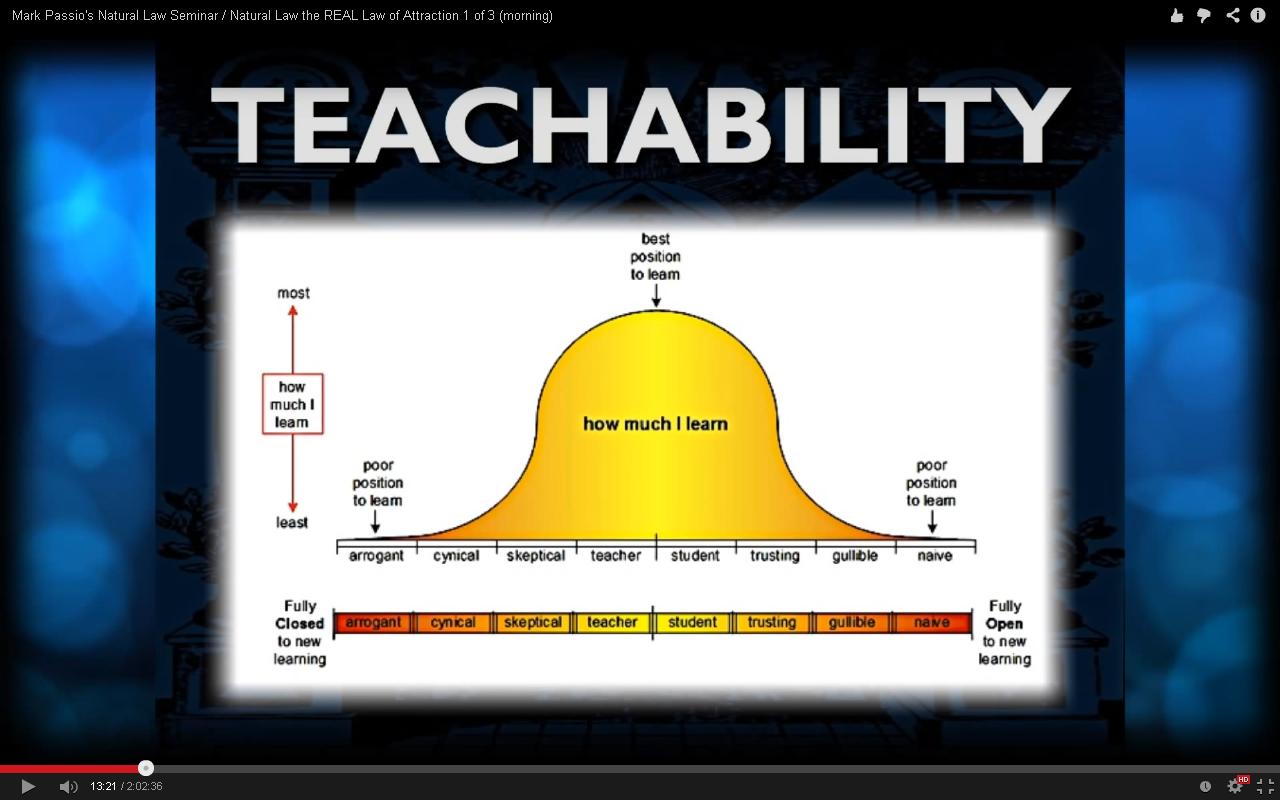

Considering yourself as both a teacher and a student is the best way to go. You don’t know everything, you’re still learning—we all are. And at the same time, you are teaching others, even when you think you’re not, with everything you ever do. Vibrate back and forth between sharing and listening, between speculations and facts, between observations and imaginations.
Include all the data and all the theories in you thoughts, even from the “unprofessionals.” Then start prioritizing your thoughts with critical analysis and true intuition. While it might seem things can be “checked off,” you never know. Keep an open mind, but challenge ideas at the same time. True learning is apophatic. You’ve got a huge pile of puzzle pieces in front of you. Problem is, plenty of those pieces don’t belong to the puzzle you’re putting together.
Eliminate every lie and the truth becomes obvious. With an agenda to know the truth, attack every belief, assault every idea, slice up every thought. And if that fails, send in the goddamn Nukes across the lands of information, take it all out, and then see what’s left standing alive. What will be there, will be truth. For truth is indestructible. Return to your senses and you’ll return to common sense. Nature doesn’t collect the useless, it discards it. You should to.

And this leads into a keystone subject related to learning, especially in relation to the Social world. It’s called: “emotional mind control.” How someone and their information makes you feel does not dictate the truth. If someone you don’t like says the truth, it’s still the truth. And if someone you do like says a lie, it’s still a lie. Your opinion of someone does not change the truth of the universe.
Even if the devil told you 2+2=4, that’s still truth. And even if god told you 2+2=5, that’s still a lie. While yes, emotions are a powerful and invaluable part of our lives, they are not the singular gauge of truth and lies. It’s sad to say, but masses of people are suffering from what I call “Perceptual Disabilities,” otherwise known as Solipsism. More about that later.
Emotions have a sly way of interfering with learning. Your emotional view of someone, the feelings you get from them, can sway your interpretation of their information to such an extent that within your mind they cannot possibly be lying. Your perception of them as a good person prevents you from considering they might be lying. And if they are actually lying, their lies feels so damn good and sound so great, why should you care about the truth? Your hopes and your fears must both be tamed before you can sunder lies from truth.
You cannot rely solely upon the way someone makes you feel to determine the truthfulness of the words coming out of their mouths. How many liars seek to make you feel bad? None of course. Liars seek to make you feel real good, so you’ll buy into their lies. How many deceivers and backstabbers will present themselves as deceivers and backstabbers? None of course. They want you to think of them as fine, upstanding, bastions of morality. How many tyrants looking for power are going to announce: “Hey, I’m a tyrant looking to enslave you!”
The immediate surface level impression of a person is not the entire content of their mind, heart, and intentions. Evil never works through its true face, it works through a million different masks. You must dig deeper, you must use every tool you can, and you must be aware of every trick used against the truth, against your learning, and against what is right in the world. A few words of the wise from my favorite fantasy books: “Beware the masks of compassion, see beyond appearances of care, know yourself what tools the trickster will use. Love is false when the shadow is denied. Don’t trust in what you want, trust in what you see.”

While this website is devoted to the overall process of learning, not the complex multi-layered operations of evil, the two are much more related than one might expect. Evil is very aware that uplifting emotions will almost always overpower critical thought. But evil does not have a monopoly on emotions. All the good folks out there should be using and understanding the power of emotions to the fullest extent. The power used against them, and the power used for their benefit.
Emotions are incredibly powerful, of course, but that power can be used for good or ill. There’s nothing wrong with feeling good, unless that feeling good is keeping the truth hidden, impeding learning, or preventing positive change for others. Your peace and well-being are not the end of the line. There is a question I keep asking everyone I can: “Is it an authentic celebration, or an entertaining distraction?”—distraction from the moral obligations to fight against the evil at work in the world.
Feeling good isn’t always a good thing, just as feeling bad isn’t always a bad thing. Feeling good can be a distraction from what actually matters. One can become lost in feeling good themselves while others suffer. Just because you’ve found your peace, doesn’t mean the world has. Feeling bad can reveal what actually matters. One can become stronger, sharper, and even immunized from evil, as a result of the experiences with the so-called “negative” emotions, and thereafter see the moral obligations they have in this life.
Emotions are not some master-guide for deciding what is wrong and right, for seeing a lie from the truth. Emotions are not to be demonized, but nor are they to be (I’m going to introduce a word here I doubt will ever get popular, but I’ll give it a shot) angelized. Just as people demonize, meaning they say something is always wrong and there’s no arguing with me, people also angelize, meaning they say something is always right and there’s no arguing with me. An emotion’s true value is always determined by its context.

This could branch into a huge complex discussion about what is right and what is wrong, but that will be done in-depth at another time. I will, however, touch upon it, for it is relevant. Right and wrong are actually quite simply when it comes to day-to-day life. Of course, there are those complex gray areas that can happen, as fiction loves to popularize, but most of the time right and wrong should be clear-cut. Right and wrong are always determined by story, by context, by situation, and by whether Free Will is being honored or dishonored, defended or intruded upon. Simply put: Right does not harm. Wrong does harm.
Let’s run a little test, to prove a point. Here’s three words, take your time, and tell yourself if they are evil or good, wrong or right.
Sex.
Rape.
Lovemaking.

Now what exactly makes Rape wrong, and Lovemaking good? The honoring or dishonoring of Free Will, which can be determined by the word alone. The word “Rape” always implies an intrusion of Free Will, of the worst kind, and because it tells enough of a story within the word itself, it can certainly be demonized. A clear context is powerfully built-in with the word. The word “Lovemaking” always implies an honoring of Free Will, I would say of the best kind, and because it tells enough a story it can certainly be angelized. A clear context is powerfully built-in with the word.
However, the word “sex” all by itself does not tell enough of story to determine if it’s right or wrong. A context is not built-in with the word. Is sex involved in the story of rape? Is sex wrong or right? Is sex involved in the story of Lovemaking? Is sex wrong or right? Sex is neither wrong nor right, more of a story is needed to determine that, and therefore sex should not be demonized nor angelized.

Automatically thinking sex=good is not a problem, I certainly do that. But the Conscious mind needs to see that automatic response and realize the deeper levels at work. You need to gather the entire story before wrong and right can be truly determined. At another time I’ll be creating a lengthy list of words for you to “emotionally check yourself” on, and think about whether or not they are actually wrong or right, or if it’s just your perception that is wrong or right.
Feel free to experiment on your own emotional responses to words, and their “wrongness” or “rightness.” If a word feels wrong, think of a situation where it could be right. If a word feels right, think of a situation where it could be wrong. Don’t just define a word, perceive its context as well. I’m sure you’ll learn a thing or two about yourself. A few examples to get you started: Power. Manipulation. Guns. Laughter. Entertainment. Depression. Change.
(And while I did choose those three words, sex, rape, and lovemaking, for the obvious differences between them to make my point clear, I also chose them for personal reasons that do not directly relate to this website. It makes me, Goddess Fyre, smile wide.)
Without story, there is no meaning. Without meaning, there is no virtue. Without virtue, there is no peace.

So, the immediate emotional response to information does not determine the truthfulness of that information. False information believed to be true can lead to powerful emotions, but those emotions will also be false. True information will lead to true emotions, or “authentic emotions.” I could give a ton of examples, but I think the false deaths and “love” based on lies, as depicted in so many Hollywood films, will give you all the examples you need.
The heart should check the mind, just as the mind should check the heart. Dividing false emotions from authentic emotions is the job of a critical and Conscious fearless mind, which is not an easy task, and it is certainly another big branch unto itself. (Don’t get me started on false love, I’ll end up writing a number of volumes here. I’m sure plenty of the brokenhearted could as well.)
Let’s run a little test, to illustrate the power of emotional mind control. The following two paragraphs are quite different from each other. Observe your automatic emotional reactions while also observing what is true and what is not. Let yourself feel what you may feel, but also discern the truth from the lies. Even if you are being insulted, truth is still truth. Imagine someone is speaking the words to you, face to face, with full intensity.
In a calming and serene voice, a beautiful human being says to you, “There is no more need for stress. There is no space left for negativity. No time need be spent on worries. The world is, as the world is. Let it be, let it flow, let it go. The universe will handle it. Here and now, all is love, all is light, all is one. Peace is given to you, and as we walk into our beautiful future together, we are truly free. Here and now is filled with boundless joy. All you need to do is open your arms to the skies, and announce that two and two equals five…”
In a chaotic and mocking voice, a disgusting Human Being says to you, “Listen here you dumb fuck, if you’d bother spending five seconds of your life doing something smart, instead of being such a fucking gullible moron over and over again, blindly believing every fancy-pants sweet-talkin’ guru and sly-tongued smiley politician that sells you a slice of serenity, you’d realize the world beneath those skies is suffering and that two and two actually equals four!”

Of course, in those examples, seeing the truth and spotting the lies are obvious, to make the point. In real life, the lies won’t be so obvious. The “sweet-talkin’ guru” and “sly-tongued smiley politician” won’t be so obvious in real life. You’ll need to deeply read between the lines, and use your own critical judgment free from emotional concern. Your power to discern truth from lies is a key for humanity’s beautiful future.
And there’s another great word to emotionally check yourself on: “Judgment.” If you’d like to know if you’re being lied to, you will need to JUDGE others. You will need to gauge, to discern, to judge whether or not they are good person or a bad person. “But it’s wrong to judge others, isn’t it?” “Judge not lest ye be judged yourself.” I guess you’ll just have to keep getting lied to than. What, you yourself aren’t afraid of getting judged, are you? Have you made friends with the skeletons in your closet yet?
The feelings you get, whether comfortable or uncomfortable, do not dictate what is true and what is not true. Following what feels good without question and without any higher concern is a fundamental road-block to learning. There is nothing wrong with feeling good, being comfortable, and having a sense of security, but there is much more going on with life, reality, and responsibility. Profoundly critical, politically incorrect, and brutally honest challenging thought must check the emotional responses if learning is to transpire.
When a person sounds nice, is very professional looking, and has gained the reputation in society of being a moral human being, the information they present is not automatically true. But at the same time, when a person sounds upsetting, is not professional looking, and has a reputation in society of being an immoral human being, the information they present is not automatically false.
A reputation about someone is not the truth about that someone. A reputation is an image, a rumor, a surface level impression. It is not the heart, the truth, the deeper levels of reality at work. A reputation is built with time, by different people and medias that may or may not be telling the truth. Everybody’s got an agenda, and it must be known if truth is to be known.
The materials that construct that “building of reputation” might very well be weak and pathetic, doomed for an early crumble, or they might be made from “the right stuff” that will last forever. Taint my image all you’d like Mr. Media, I trust in my fellow human beings to see through the lies.

It is the foundation that determines the reach, the core that decides the outsides, the fundamentals that dictate the eventual. We’ve all heard of the public figure with the perfect public image, who was then tainted by one little thing, or perhaps one big thing. But if they have a foundation solid enough, their image can remain free from ruin.
The foundation (meaning the belief systems) of a mind can be so strong it can support an exploration into Infinity. It can consider all possibilities, it can “go there.” Or, the foundation of a mind, its belief systems, can be so weak a foundation is practically non-existent, and therefore it would crumble from the weight of only the first test, the first step up, the first story.
If a few choice words upset your foundation, you’re not building squat. Because you have to be ether IGNORant of everything that threatens your pathetic foundation, or throw out your every belief and totally start over from scratch. And in such a situation, when a mind’s foundation is that weak, nothing of lasting value can ever be built. Ruin becomes the only resolution.
And that is why the fundamentals, the principles, the core, is so important. If you want to learn, Consciously see that anything is possible, realize your own inherent powers, your Free Will, embrace the dance of objectivity and subjectivity, and equip yourself with the toolset needed to build up to the next level, forever. This basic model, of a foundation with a building on top, is a great metaphor for many different things in life—specifically for learning itself.
 Fy's Blogs